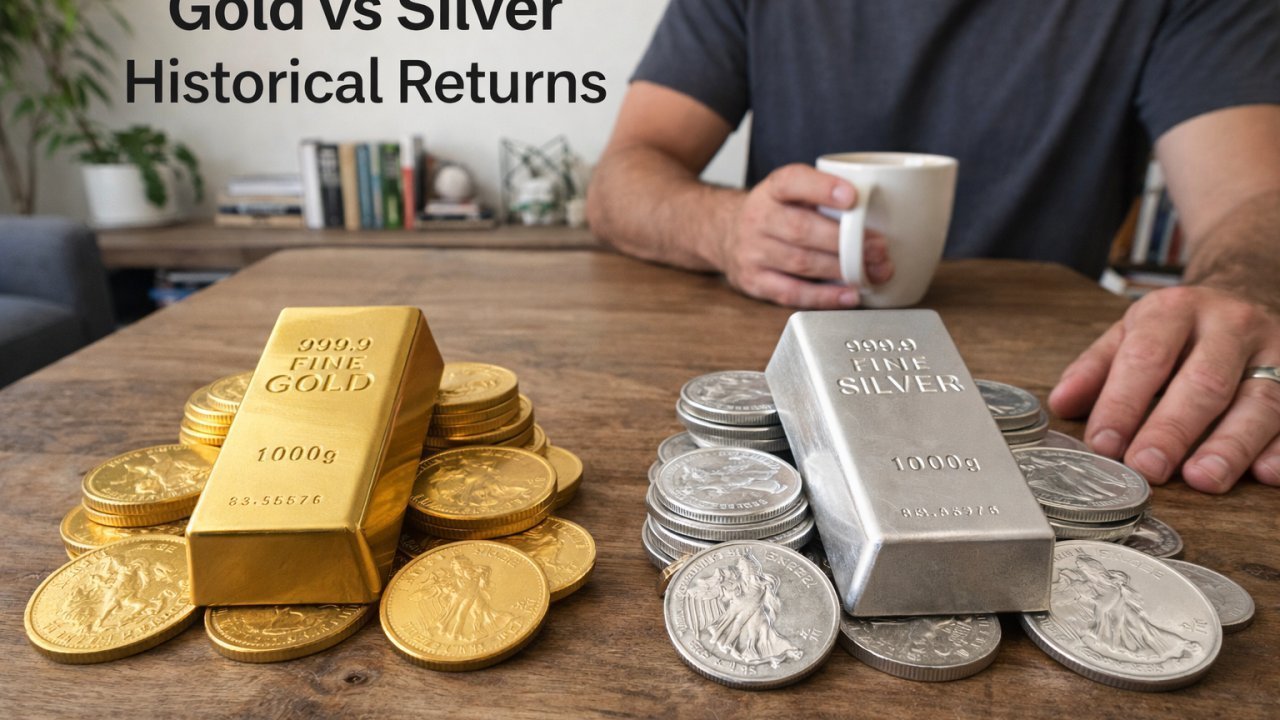
Gold Vs Silver Historical Returns
By Admin · February 16, 2026
- Long-term Wealth Creation: While Gold has historically provided steady returns of around 9-11% CAGR over the last 20 years, Silver is more volatile but often outperforms Gold during aggressive bull markets.
- Safe Haven vs. Industrial Asset: Gold acts primarily as a hedge against inflation and currency devaluation, whereas Silver's price is heavily influenced by industrial demand in electronics and renewable energy.
- The Gold-Silver Ratio: This metric is a crucial tool for Indian investors to determine which metal is undervalued at any given point in time.
- Taxation and Liquidity: Understanding the impact of GST and Capital Gains tax is essential for calculating the actual net returns on your precious metal investment.
For generations, Indian households have viewed precious metals not just as ornaments, but as the ultimate financial safety net. Whether it is the purchase of a heavy gold necklace for a wedding or the tradition of buying silver coins during Dhanteras, these metals are deeply woven into the socio-economic fabric of the country. However, as the Indian financial landscape evolves with the rise of digital assets and equity markets, a critical question emerges for the modern investor: Between Gold and Silver, which has historically delivered better returns, and where should you put your hard-earned money today?
Deciding between these two metals requires more than just checking the Today Gold Rate. It demands a deep dive into historical cycles, an understanding of global macroeconomic shifts, and a clear-eyed look at how the Indian Rupee's depreciation impacts local prices. In this analysis, we will strip away the emotional bias and look at the hard data to help you navigate your investment journey.
The Historical Trajectory: Gold vs Silver Over the Decades
When we look at the performance of precious metals in India, we must account for two factors: the global dollar price and the USD-INR exchange rate. Because India imports the vast majority of its gold and silver, any weakness in the Rupee automatically pushes the Gold Price India higher, even if global prices remain stagnant.
The 20-Year Perspective (2004–2024)
If we look back twenty years, the transformation is staggering. In the early 2000s, gold was hovering around ₹5,000 to ₹6,000 per 10 grams. Fast forward to 2024, and we are seeing prices breach the ₹75,000 mark. This represents a compounded annual growth rate (CAGR) that has consistently beaten retail inflation in India. Gold has provided a sense of "quiet wealth"—it doesn't shout with 50% gains in a single year very often, but it also rarely sees the gut-wrenching 40% drops common in the stock market.
Silver, on the other hand, is often referred to as the "Restless Metal." Its historical returns are characterized by long periods of stagnation followed by explosive vertical moves. For instance, between 2009 and 2011, silver prices in India skyrocketed, significantly outperforming gold. However, it also spent much of the mid-2010s in a slumber. For an Indian investor, silver has historically required better timing than gold to achieve maximum profitability.
The Recent 5-Year Surge
The last five years have been a rollercoaster for global markets. From the COVID-19 pandemic to geopolitical tensions in Eastern Europe and the Middle East, the "uncertainty premium" has been high. During this period, Gold has acted as a classic diversifier. When equity markets crashed in March 2020, gold stood tall. Silver initially lagged but eventually caught up as industrial activity resumed. Currently, the 22K Gold Price remains a key benchmark for retail consumers, reflecting a steady upward trend driven by central bank purchases and domestic festive demand.
Analyzing the Gold-Silver Ratio
To understand historical returns, one must master the Gold-Silver Ratio. This ratio tells us how many ounces of silver it takes to buy one ounce of gold. Historically, whenever this ratio stretches beyond 80 or 90, silver is considered "cheap" relative to gold. Conversely, when the ratio drops toward 40 or 50, gold is the better value buy.
For an Indian investor looking at Investment opportunities, this ratio serves as a mean-reversion indicator. Over the last 30 years, silver has often played catch-up. When gold prices rise significantly, silver eventually follows, often with higher velocity. If you had invested in silver when the ratio was at record highs in 2020, your returns today would likely exceed those of a gold-only portfolio.
Factors Influencing Gold Price India
Understanding why the Today Gold Rate fluctuates is vital for timing your entry. In India, several local and global factors converge to dictate the price of the yellow metal.
1. Rupee Depreciation
The Indian Rupee has historically depreciated against the US Dollar by about 3-5% annually over the long term. Since gold is denominated in dollars globally, this depreciation acts as an additional tailwind for Indian investors. Even if gold prices remain "flat" in international markets, the Gold Price India often rises simply because the Rupee has weakened.
2. Import Duties and Government Policy
The Indian government frequently adjusts import duties on gold and silver to manage the Current Account Deficit (CAD). A hike in duty immediately increases the local price, while a cut—as seen in the 2024 Union Budget—can lead to a sharp, temporary correction. Investors need to stay updated on these policy shifts as they directly impact the 22K Gold Price in the physical market.
3. Central Bank Reserves
The Reserve Bank of India (RBI) has been a consistent buyer of gold in recent years. This institutional backing provides a floor to the price. When central banks across the globe diversify away from the US Dollar, gold is the primary beneficiary, reinforcing its status as a premier Investment asset.
Silver: The Industrial Wildcard
While gold is 90% an investment and jewelry asset, silver is a hybrid. More than 50% of global silver demand comes from industrial applications. This is a double-edged sword for returns.
The Green Energy Transition
The shift toward Electric Vehicles (EVs) and Solar Energy is a massive structural driver for silver. Solar panels require significant amounts of silver paste. As India pushes toward its renewable energy goals, the domestic demand for silver is expected to outpace supply. This industrial tilt means that in a booming economy, silver can outperform gold. However, in a recession, silver often suffers more because industrial demand dries up, whereas gold thrives on the fear factor.
Pros and Cons: A Comparative Framework
Gold: The Steady Anchor
- Pros: Extremely high liquidity; lower volatility; emotional and cultural value; available in various forms like Sovereign Gold Bonds (SGBs) which offer 2.5% interest.
- Cons: Lower growth potential during industrial booms; high making charges on physical jewelry.
Silver: The High-Beta Play
- Pros: Lower entry barrier (cheaper per gram); massive upside potential during bull runs; growing industrial utility.
- Cons: High storage costs (it’s bulky); 3% GST applies just like gold but resale spreads can be wider; significantly higher price swings.
Investment Avenues in India
Gone are the days when buying a "biscut" or a coin was the only way to invest. Today, the method of Investment matters as much as the asset itself.
Sovereign Gold Bonds (SGBs)
For gold, SGBs are arguably the best instrument for Indian citizens. They eliminate storage risks, offer a 2.5% annual interest, and provide tax-free capital gains if held until maturity. If your goal is purely tracking the Gold Price India for profit, this is the gold standard.
Silver ETFs and Digital Silver
Until recently, silver investors were forced to hold physical metal. With the introduction of Silver ETFs and Fund of Funds in India, you can now invest in silver with the click of a button. This has improved liquidity and narrowed the buy-sell spread, making silver a more viable short-to-medium term trading asset.
Physical Jewelry and 22K Gold
Most Indian households track the 22K Gold Price because that is the purity used for jewelry. While jewelry is a great cultural asset, it is a poor investment vehicle due to making charges (which can range from 8% to 25%) and the loss of value upon melting. For pure investment, 24K coins or digital formats are always preferable.
Strategic Advice: How to Allocate?
A balanced portfolio shouldn't choose between gold and silver but rather determine the right proportion of each. Financial planners often suggest a 10-15% allocation to precious metals within a diversified portfolio.
If you are a conservative investor looking for capital preservation, a 4:1 ratio in favor of gold is advisable. Gold’s stability will protect you during market crashes. However, if you have a higher risk appetite and believe in the global technology and green energy story, increasing your silver allocation to 30% or 40% of your metal portfolio could provide the "alpha" or extra returns you are looking for.
Always keep an eye on the Today Gold Rate but don't let daily fluctuations trigger panic. Precious metals are a marathon, not a sprint. The real returns are realized over 5 to 10-year horizons, where the effects of inflation and currency devaluation become most apparent.
Final Thoughts
The historical returns of gold and silver in India tell a story of resilience. Gold has proven itself as the ultimate protector of purchasing power, especially in a country where the currency has a history of gradual weakening. Silver has shown that it can be a powerful wealth multiplier for those who have the patience to sit through its volatile phases.
As you monitor the Gold Price India, remember that these metals serve a purpose that stocks and mutual funds cannot: they are the only financial assets that are not someone else's liability. Whether you choose the stability of 22K Gold Price jewelry or the industrial potential of silver, you are participating in a tradition of wealth building that has stood the test of time for millennia.
Frequently Asked Questions
Is silver a better investment than gold for 2024-25?
Silver has the potential to outperform gold in a high-growth industrial environment due to its role in solar energy and electronics. However, it carries much higher volatility. If you can handle price swings, silver offers higher upside; if you want stability, gold remains the better choice.
Why is there a difference between 24K and 22K Gold Price?
24K gold is 99.9% pure and is used for investment bars and coins. 22K gold contains 91.6% gold mixed with other metals like copper or zinc to make it durable for jewelry. Therefore, the 22K gold price is always lower than the 24K price, reflecting the lower gold content.
How does the 'Today Gold Rate' affect my long-term returns?
Daily fluctuations in the Today Gold Rate have minimal impact on long-term investors. However, buying during significant market corrections or when the rupee is strong can slightly improve your CAGR. It is generally better to use a SIP (Systematic Investment Plan) approach for precious metals rather than trying to perfectly time the market.