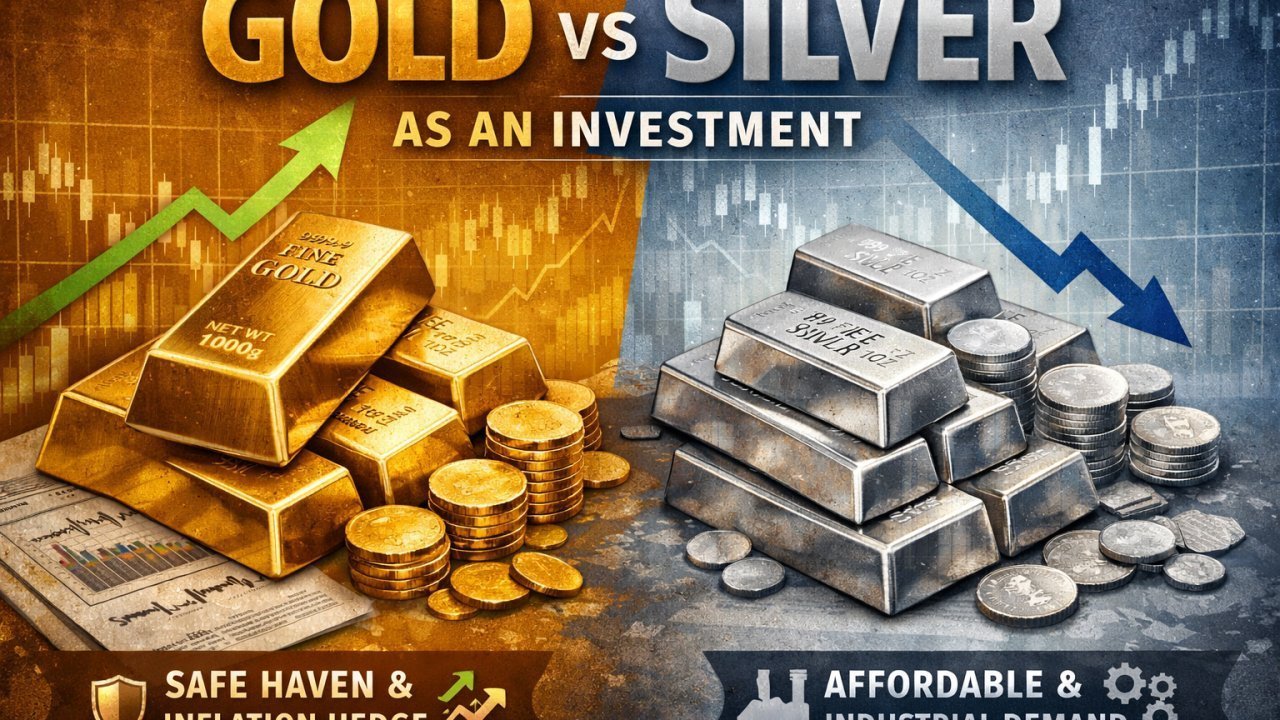
Gold vs Silver as an Investment
By Admin · February 15, 2026
- Gold offers stability, cultural significance, and acts as a traditional hedge against inflation and economic uncertainty, making it a cornerstone for many Indian investment portfolios.
- Silver, with its dual role as a precious and industrial metal, presents higher growth potential due to increasing demand from green technologies and electronics, but also comes with greater price volatility.
- The optimal choice between gold and silver, or a combination of both, depends heavily on an investor's risk appetite, investment horizon, and their specific financial goals within the dynamic Indian market context.
- Understanding the Gold-Silver Ratio and global economic trends is crucial for Indian investors to make informed decisions and diversify their precious metal holdings effectively.
Gold vs. Silver: Unveiling the Best Precious Metal Investment for Indian Investors
In the vibrant tapestry of Indian finance and culture, precious metals hold a unique and revered position. Gold and silver are not merely commodities; they are integral to traditions, wealth preservation, and aspirations across generations. For centuries, Indian families have instinctively turned to these gleaming assets as a store of value, a symbol of prosperity, and a hedge against life's uncertainties. However, in today's complex global economy, the age-old question persists: which metal offers a superior investment opportunity? Is it the timeless appeal of gold, or the dynamic potential of silver?
This comprehensive guide delves deep into the nuances of investing in gold versus silver, specifically tailored for the Indian investor. We will explore their distinct characteristics, market drivers, historical performance, and practical considerations, helping you navigate the glittering world of precious metals to make an informed decision for your portfolio. From understanding the daily Gold Price India to assessing silver's industrial demand, we aim to equip you with the insights needed to strategically position your investment.
The Enduring Allure: Gold as an Investment
Gold, often referred to as 'yellow metal', holds an unparalleled status in India. Its significance transcends mere monetary value, deeply embedded in religious ceremonies, weddings, festivals, and as a primary form of inherited wealth. This cultural bedrock provides an inherent demand floor that often insulates gold prices in India from some global fluctuations.
Why Gold Resonates in India
For an Indian investor, gold is more than just an asset; it's a symbol of security and prosperity. During times of economic stability, it’s bought for adornment and celebration. In periods of inflation or currency depreciation, it acts as a reliable safe haven, preserving purchasing power. The ease with which one can check the Today Gold Rate and liquidate physical gold makes it a highly liquid asset, particularly in rural and semi-urban areas where formal financial instruments might be less accessible.
The consistent demand for physical gold in India, whether in the form of jewellery (often 22K Gold Price being the benchmark), coins, or bars, creates a robust internal market. This domestic demand often influences the Gold Price India, making it a critical factor for local investors.
Gold's Investment Pros
- Safe Haven Asset: Gold has a proven track record of performing well during economic downturns, geopolitical instability, and periods of high inflation. It tends to be inversely correlated with the stock market and the US dollar, offering diversification.
- Store of Value: Over centuries, gold has maintained its purchasing power, making it an excellent long-term store of wealth, especially against currency devaluation.
- High Liquidity: Gold is highly liquid globally and exceptionally so in India. It can be easily bought and sold through various channels, from jewellers to banks and online platforms.
- Cultural and Sentimental Value: For Indian investors, gold carries immense cultural and sentimental value, driving consistent demand regardless of market conditions.
- Hedge Against Inflation: As the cost of living rises, gold prices often follow suit, protecting investors from the erosive effects of inflation.
- Diverse Investment Avenues: Beyond physical gold, Indian investors can choose from Sovereign Gold Bonds (SGBs) offering interest and tax benefits, Gold ETFs for paper gold exposure, and Gold Mutual Funds for professional management.
Gold's Investment Cons
- No Income Generation: Unlike stocks (dividends) or bonds (interest), gold does not generate any periodic income. Its returns are purely based on capital appreciation.
- Storage Costs and Security: Holding physical gold necessitates secure storage, which can incur costs (e.g., bank lockers) and carries inherent security risks.
- Making Charges and Purity Concerns: When buying gold jewellery, investors often pay significant 'making charges' (wastage), which are not recovered upon sale. Purity verification (hallmarking) is crucial but still requires diligence.
- Lower Growth Potential: While stable, gold's growth potential is often lower compared to more volatile assets like equities or even silver, especially during periods of strong economic growth.
- Impact of Government Policies: Import duties, GST, and other government regulations can significantly impact the Gold Price India and affect investment returns.
The Industrial Powerhouse: Silver as an Investment
Often dubbed 'poor man's gold', silver shares some characteristics with its yellow counterpart but possesses a distinct identity, primarily driven by its extensive industrial applications. While it has a history as a monetary metal, silver's modern demand profile is significantly influenced by technological advancements.
Silver's Dual Nature
Silver's appeal as an investment stems from its dual identity: it is both a precious metal and a vital industrial commodity. As a precious metal, it benefits from safe-haven demand, albeit to a lesser extent than gold. Its true differentiator lies in its industrial utility. Silver is an indispensable component in solar panels, electric vehicles, electronics (smartphones, computers), medical instruments, and photography. This industrial demand creates a unique dynamic for silver prices, tying them more closely to global economic growth and technological innovation.
Silver's Investment Pros
- Higher Growth Potential: Due to its significant industrial demand, silver prices can experience sharper upward movements during periods of economic expansion and technological breakthroughs.
- Affordable Entry Point: Silver is considerably cheaper per ounce than gold, making it more accessible for smaller investors to accumulate substantial quantities.
- Diversification: While correlated with gold, silver also has a strong correlation with industrial commodities, offering a different layer of diversification within a precious metals portfolio.
- Green Technology Demand: The global shift towards renewable energy (solar power) and electric vehicles is a significant long-term demand driver for silver, promising sustained growth.
- High Malleability and Conductivity: These physical properties make silver irreplaceable in many high-tech applications, ensuring consistent industrial demand.
Silver's Investment Cons
- Higher Volatility: Silver prices are notoriously more volatile than gold, experiencing larger price swings due to the combined influence of investment demand and fluctuating industrial consumption.
- Less of a "Safe Haven": While it shares some safe-haven attributes, silver is generally not perceived as strongly as gold in times of extreme crisis due to its industrial ties.
- Storage Challenges: Due to its lower value-to-weight ratio, storing a significant value of physical silver requires more space and can be cumbersome.
- Industrial Demand Sensitivity: A global economic slowdown or a downturn in manufacturing can significantly impact industrial demand for silver, leading to price drops.
- Purity and Liquidity Concerns (Physical): While relatively liquid, the market for large quantities of physical silver might be less robust than gold in certain local Indian markets, and purity verification is equally important.
Gold vs. Silver: A Comparative Analysis for Indian Investors
To truly decide between gold and silver, or how to allocate between them, it's essential to compare them across several critical investment parameters relevant to the Indian context.
Volatility and Price Swings
Historically, silver has been significantly more volatile than gold. This is primarily because gold's price is predominantly driven by monetary factors (inflation, interest rates, central bank policies, geopolitical risk), whereas silver's price is influenced by both monetary factors and industrial demand. When economies are booming, industrial demand for silver surges, leading to rapid price increases. Conversely, during recessions, industrial demand plummets, causing sharper declines. Gold, while not immune to volatility, tends to exhibit more stability, making it a preferred choice for risk-averse investors seeking consistent wealth preservation.
Correlation with Other Assets
Gold often shows a negative correlation with the US dollar and equity markets, meaning when these assets fall, gold tends to rise. This makes gold an excellent portfolio diversifier. Silver, while also having some inverse correlation with the dollar, often exhibits a stronger positive correlation with industrial commodities and the overall economic cycle. This means silver might move in tandem with equities during boom periods but could also fall more sharply during downturns, offering a different type of diversification.
Liquidity and Accessibility
In India, gold undoubtedly enjoys superior liquidity. From small-town jewellers to major banks, buying and selling gold is a straightforward process. The Today Gold Rate is widely published and understood. While silver is also liquid, especially in larger cities and through commodity exchanges, finding buyers for very large quantities of physical silver might require more effort compared to gold in certain remote areas. For smaller denominations, both are easily accessible.
Storage and Purity Concerns
Physical gold, given its higher value density, is relatively easier and less costly to store securely than an equivalent value of physical silver. A small gold bar or coin holds significant value, whereas the same value in silver would occupy considerably more space, potentially increasing storage costs or security risks. Purity verification is crucial for both metals. Hallmarking for gold (especially 22K Gold Price items) is now more stringent in India, providing a level of assurance. Investors buying physical silver should also ensure they purchase from reputable dealers and verify purity.
Current Market Dynamics and Future Outlook
The global economic landscape, central bank policies, and technological advancements significantly influence both metals. Gold's future remains tied to inflation concerns, geopolitical tensions, and central bank buying. The ongoing uncertainty regarding global growth and interest rates could continue to support gold prices. Silver's future, however, is increasingly linked to the green energy revolution. The massive investment in solar power, electric vehicles, and 5G technology projects sustained, robust demand for silver for decades to come. This structural demand shift could provide a powerful tailwind for silver prices, potentially outperforming gold in the long run if these trends accelerate.
The Gold-Silver Ratio, which indicates how many ounces of silver it takes to buy one ounce of gold, is a key metric. Historically, this ratio has fluctuated, but when it's high (meaning silver is relatively cheap compared to gold), some investors see it as an opportunity to buy silver, anticipating a reversion to the mean. Indian investors should monitor this ratio closely as part of their decision-making process.
Crafting Your Portfolio: Strategic Considerations for Indian Investors
The choice between gold and silver is not necessarily an 'either/or' proposition. Many savvy Indian investors choose to include both in their portfolios for balanced diversification. Here's how to approach it:
- Risk Appetite: If you are a conservative investor prioritizing wealth preservation and stability, a higher allocation to gold might be suitable. If you have a higher risk tolerance and are seeking potentially greater returns, a larger silver allocation could be considered.
- Investment Horizon: For short-term tactical plays, silver's volatility might offer quick gains (or losses). For long-term wealth building and inflation hedging over decades, gold is often the preferred choice. However, silver's long-term industrial demand story also makes it compelling for patient investors.
- Diversification Goals: Precious metals generally act as a hedge against inflation and economic uncertainty. Gold provides a more direct hedge against currency depreciation and systemic risk, while silver offers exposure to industrial growth and technological trends. A combination offers broader diversification.
- Forms of Investment:
- Physical Gold/Silver: Jewellery, coins, bars. Best for those who value tangibility and cultural significance. Be mindful of making charges for jewellery and storage for both. For gold, always check for BIS hallmark and compare 22K Gold Price from reputable dealers.
- Sovereign Gold Bonds (SGBs): Issued by the RBI, SGBs offer a safe alternative to physical gold, providing interest payments and tax benefits upon maturity. They track the Gold Price India without the hassle of physical storage.
- Gold/Silver ETFs: Exchange-Traded Funds tracking the price of the respective metal. They offer liquidity, transparency, and eliminate storage concerns.
- Gold/Silver Mutual Funds: Funds that invest in gold/silver ETFs or mining companies. Managed by professionals, offering convenience.
- Digital Gold/Silver: Available through various platforms, allowing fractional ownership and easy buying/selling.
- Monitoring Market Trends: Keep an eye on global economic indicators, interest rate decisions by central banks, industrial production data, and the Today Gold Rate and silver prices. The Gold-Silver Ratio can provide insights into relative valuations.
Conclusion: Making Your Informed Choice
Both gold and silver offer compelling reasons for inclusion in an Indian investor's portfolio, but they serve different roles. Gold stands as the unwavering pillar of stability, a timeless hedge against uncertainty, deeply woven into India's cultural and financial fabric. Its consistent demand and safe-haven status make it an indispensable asset for wealth preservation. Silver, on the other hand, is the dynamic performer, offering higher growth potential driven by its critical role in the accelerating green and digital revolutions, albeit with greater price swings.
Ultimately, the "better" investment depends on your individual financial goals, risk tolerance, and investment horizon. For many Indian investors, a balanced approach combining both metals offers the best of both worlds: the stability and cultural resonance of gold alongside the growth potential of silver. Before making any significant investment, it is always wise to consult with a financial advisor who can help tailor a strategy best suited to your unique circumstances, always keeping an eye on the evolving Gold Price India and global market dynamics.
By understanding the unique characteristics of each metal and how they align with your financial objectives, you can confidently navigate the precious metals market and strengthen your investment portfolio for the future.
Frequently Asked Questions (FAQ)
Is gold or silver better for long-term investment in India?
For long-term wealth preservation and as a traditional safe haven against inflation and economic uncertainty, gold is generally considered superior due to its lower volatility and consistent demand in India. However, silver's strong industrial demand from emerging technologies (solar, EVs) could give it higher growth potential over the very long term, making it an attractive addition for investors with a higher risk appetite.
How does the Gold-Silver Ratio help investors?
The Gold-Silver Ratio indicates how many ounces of silver it takes to buy one ounce of gold. Historically, this ratio fluctuates. When the ratio is high (meaning silver is relatively cheap compared to gold), some investors view it as an opportunity to buy silver, anticipating that the ratio will eventually revert to its historical mean, thus increasing silver's value relative to gold. Conversely, a low ratio might suggest silver is overvalued compared to gold. It's a tool for relative valuation, not a standalone buy/sell signal.
What are the best ways to invest in gold and silver in India?
For gold, popular options include physical gold (jewellery, coins, bars – always check 22K Gold Price and hallmarking), Sovereign Gold Bonds (SGBs) for interest and tax benefits, Gold Exchange Traded Funds (ETFs) for paper gold, and Gold Mutual Funds. For silver, investors can buy physical silver (bars, coins), Silver ETFs, or Silver Mutual Funds. Digital gold and silver platforms also offer convenient ways to invest in smaller denominations without storage hassles.