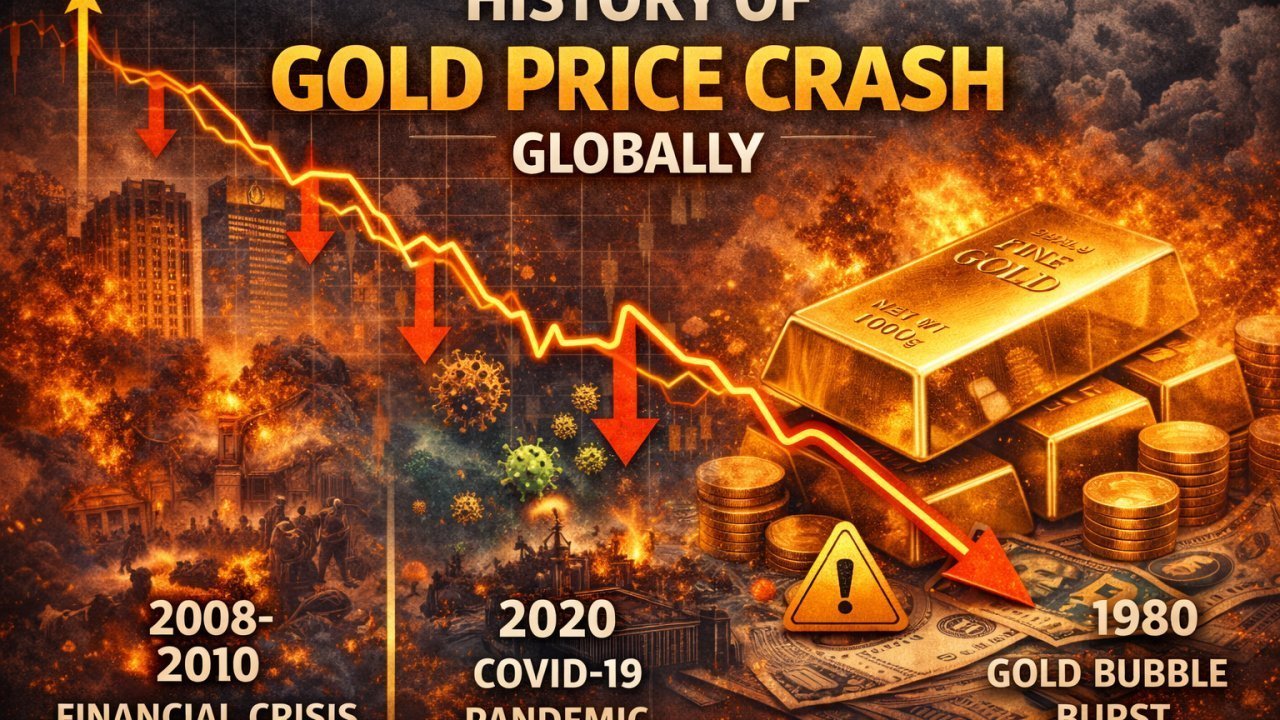
History of gold price crash globally
By Admin · February 15, 2026
- Gold is not immune to volatility: While often considered a "safe haven," historical data shows that gold has experienced several massive price corrections, sometimes losing over 20% of its value in a single year.
- Interest rates are the primary catalyst: Most global gold crashes are directly linked to the US Federal Reserve's monetary policy; rising interest rates increase the opportunity cost of holding non-yielding assets like gold.
- The 2013 "Taper Tantrum" remains a benchmark: The most significant modern crash occurred in 2013 when gold prices plummeted by nearly 28%, teaching Indian investors that global liquidity shifts have immediate local impacts.
- Indian local factors provide a cushion: Due to the continuous depreciation of the Indian Rupee (INR) against the US Dollar and high import duties, the Gold Price India often falls less sharply than global spot prices.
In the bustling markets of Zaveri Bazaar in Mumbai or the jewelry hubs of Kerala, gold is more than just a metal—it is a cultural heartbeat. For generations, Indian households have viewed gold as the ultimate insurance policy against economic ruin. However, the narrative that gold prices only go up is a dangerous myth. While the long-term trajectory of gold has been upward, the history of the bullion market is littered with dramatic crashes that have wiped out portfolios and shaken investor confidence.
Understanding the history of gold price crashes is essential for anyone tracking the Today Gold Rate with an eye on Investment. By analyzing why the "yellow metal" occasionally loses its luster, we can better navigate the volatile cycles of the global economy and make informed decisions about when to buy and when to hold.
The Great Crash of 1980: The End of the Hunt Brothers Era
The most spectacular gold crash in modern history occurred in 1980. To understand this crash, one must look at the preceding decade. In the 1970s, the world was grappling with hyperinflation, geopolitical instability (the Iranian Revolution), and the collapse of the Bretton Woods system. Gold surged from $35 an ounce in 1971 to a staggering peak of $850 in January 1980.
The Role of the Hunt Brothers
Much of this surge was artificial, fueled by the Hunt brothers, who attempted to corner the silver market, which in turn dragged gold prices higher. However, the bubble burst when the US Federal Reserve, under Paul Volcker, took drastic measures to curb inflation. Interest rates were hiked to a record 20%, making the US Dollar incredibly attractive and making the cost of holding gold—which pays no interest—prohibitively expensive.
The Aftermath
By 1982, gold had crashed to nearly $300 an ounce. For the Indian investor of that era, this was a period of stagnation. The global crash meant that gold remained in a "bear market" for nearly two decades. This period taught the world that when real interest rates (nominal rates minus inflation) are high, gold loses its appeal as an Investment vehicle.
The 1990s: The 'Brown Bottom' and Central Bank Selling
The late 1990s represented a different kind of crash—a slow, agonizing decline that saw gold reach a low of around $250 an ounce in 1999. This era is often remembered for the "Brown Bottom," named after Gordon Brown, the then-UK Chancellor of the Exchequer, who decided to sell a massive portion of the UK’s gold reserves at the absolute bottom of the market.
Why did Central Banks turn on Gold?
During this period, the global economy was stable, inflation was low, and the "Dot-com" boom was in full swing. Investors preferred the high returns of technology stocks over the perceived "dead weight" of gold. Central banks across Europe began to view gold as an antiquated asset that yielded no dividends. Their massive sell-offs created a supply glut, keeping the 22K Gold Price in India depressed for years.
Lessons in Sentiment
This period proved that gold depends heavily on "opportunity cost." If the stock market is booming and providing 20% annual returns, gold—even if it stays stable—is viewed as a losing trade. It wasn't until the early 2000s, with the 9/11 attacks and the onset of the Iraq War, that gold's "safe haven" status was restored.
The 2013 Crash: The 'Great Gold Taper Tantrum'
For the modern Indian investor, the 2013 crash is the most relevant. After the 2008 financial crisis, gold entered a massive bull run, reaching an all-time high of $1,920 in 2011. Analysts were predicting $2,500 or even $5,000. Then, the floor fell out.
The Catalyst: QE Tapering
In April 2013, gold saw its largest two-day drop in 30 years. The primary reason was the US Federal Reserve's signal that it would begin "tapering" its Quantitative Easing (QE) program. As the US economy showed signs of recovery, the need for emergency stimulus faded. This led to a massive liquidation by institutional investors and Exchange Traded Funds (ETFs).
The Indian Impact
In India, the crash was doubly painful. The government, struggling with a high Current Account Deficit (CAD), had recently hiked import duties on gold. When the global price crashed, the Gold Price India saw a massive correction, leading to a frantic rush at jewelry stores. However, those who bought at the peak in 2011 had to wait nearly seven years just to break even in nominal terms. This event highlighted that even in a gold-obsessed nation, the Today Gold Rate is ultimately slave to the US Federal Reserve's balance sheet.
The Flash Crash of 2021: Liquidity Traps
While not a sustained multi-year crash, the "flash crash" of August 2021 provides a modern case study in market mechanics. During a quiet trading session in Asia, gold prices dropped by over $60 in a matter of minutes. This wasn't caused by a change in economic fundamentals, but by high-frequency trading algorithms and "stop-loss" orders being triggered during a period of low liquidity.
For retail investors checking the 22K Gold Price, these sudden dips can be terrifying. They serve as a reminder that the gold market is now heavily influenced by digital trading and institutional leverage, not just physical demand for weddings in India.
Factors That Cause Gold Prices to Crash
To predict the next correction, we must understand the levers that move the market. Gold does not exist in a vacuum; it is part of a complex global financial ecosystem.
1. Real Interest Rates
This is the single most important factor. Gold is a non-yielding asset. If you can get a 5% "real" return (interest rate minus inflation) from a US Treasury bond, why would you hold gold? When interest rates rise sharply, gold prices almost always crash.
2. The Strength of the US Dollar (DXY)
Gold is priced in US Dollars globally. There is an inverse relationship between the two. When the Dollar is strong, it takes fewer Dollars to buy the same amount of gold, causing the price to drop. For Indian buyers, a strong Dollar also means a weaker Rupee, which can sometimes mask the global price drop in the local Gold Price India.
3. Central Bank Policy
Central banks hold about one-fifth of all gold ever mined. If major players like the IMF, the US Fed, or the RBI decide to liquidate reserves to manage currency volatility or debt, the sudden influx of supply can crash the market.
Pros and Cons of Investing During a Gold Price Crash
When the Today Gold Rate starts to tumble, investors are often paralyzed by fear. However, a crash presents both a crisis and an opportunity.
Pros
- Lower Entry Point: For long-term Investment, crashes allow you to average down your cost. In India, buying "on the dips" is a time-tested strategy for accumulating wealth for future needs like marriages or education.
- Increased Physical Demand: In India, a price crash often leads to a surge in jewelry sales, which can create a "floor" for the price, preventing it from falling as far as it might in Western markets.
- Portfolio Rebalancing: A crash allows you to reallocate funds from overvalued assets into gold at a discount.
Cons
- Opportunity Cost: During a crash, your capital is locked in a declining asset while other sectors (like equities or real estate) might be booming.
- Psychological Stress: Unlike a stock that might pay dividends, gold provides no cash flow. Watching its value drop can be emotionally taxing for conservative investors.
- Liquidity Issues: During extreme market panics, the "spread" between buying and selling prices at local jewelers can widen, making it harder to exit your position profitably.
The Indian Perspective: Why Our Prices are Different
It is a common observation that when global gold prices fall by 5%, the Gold Price India might only fall by 2%. Why is there a disconnect? The Indian gold price is a derivative of three main factors:
- International Spot Price: The base price set in London or New York (in USD).
- USD/INR Exchange Rate: Since India imports almost all its gold, we pay in Dollars. If the Rupee weakens, gold becomes more expensive in India, even if global prices are flat.
- Import Duties and Taxes: The Indian government frequently adjusts the Customs Duty and GST (Goods and Services Tax) on gold to manage the economy. A hike in duty can offset a global price crash.
When looking at the 22K Gold Price for jewelry, one must also account for "making charges," which do not fluctuate with the market, further cushioning the impact of a global crash for the end consumer.
How to Protect Your Investment from a Crash
No one can predict a crash with 100% accuracy, but you can build a resilient strategy. Diversification is key. Financial advisors often suggest that gold should make up 5% to 15% of your total portfolio—enough to provide a hedge, but not so much that a crash ruins your financial future.
Instead of buying all at once, use the "Systematic Investment Plan" (SIP) approach. Whether you are buying Digital Gold, Sovereign Gold Bonds (SGBs), or physical coins, spreading your purchases over time ensures that you benefit from the Today Gold Rate without being overly exposed to a single market peak.
The Verdict: Is Gold Still a Safe Bet?
History shows that gold crashes are usually followed by even stronger rallies. The 1980 crash was followed by the massive bull run of the 2000s. The 2013 crash eventually led to the record highs seen in 2020 and 2024. Gold is a cyclical asset. It thrives on fear, inflation, and uncertainty, and it suffers during periods of high growth and high interest rates.
For the Indian audience, gold remains a vital part of a balanced financial life. While the history of gold price crashes serves as a cautionary tale, it also reinforces the metal's permanence. Paper currencies may come and go, and companies may go bankrupt, but gold has never gone to zero. The key is to buy with a long-term horizon and never let the "glitter" of a bull market blind you to the reality of market cycles.
Frequently Asked Questions
Why does gold price fall when the US Dollar gets stronger?
Gold is globally traded in US Dollars. When the Dollar strengthens, it gains more purchasing power, meaning it takes fewer Dollars to buy the same ounce of gold. This mathematically pushes the gold price down. Additionally, a strong Dollar usually signals a healthy US economy, which prompts investors to move money out of "safe" gold and into "risky" but higher-yielding assets like stocks.
What was the lowest gold price in India in the last 20 years?
In the early 2000s (around 2001-2003), gold was trading at approximately ₹4,000 to ₹5,000 per 10 grams in India. Since then, the combination of rising global prices, a weakening Rupee, and increased import duties has pushed the price significantly higher. While there have been temporary crashes (like in 2013), the long-term trend in India has been steeply upward due to currency depreciation.
Is it a good idea to buy gold when the price is crashing?
Historically, buying during a crash has been a profitable strategy for long-term investors, but it requires patience. In the 2013 crash, those who "bought the dip" too early saw further losses for months. The best approach is "staggered buying"—purchasing small amounts as the price drops rather than trying to time the absolute bottom. Always ensure you are checking the 22K Gold Price from reliable sources before making a physical purchase.